Clean folds, rich colour and paper that holds its shape – print brochures that read properly panel by panel, from the counter stand to the buyer’s desk.
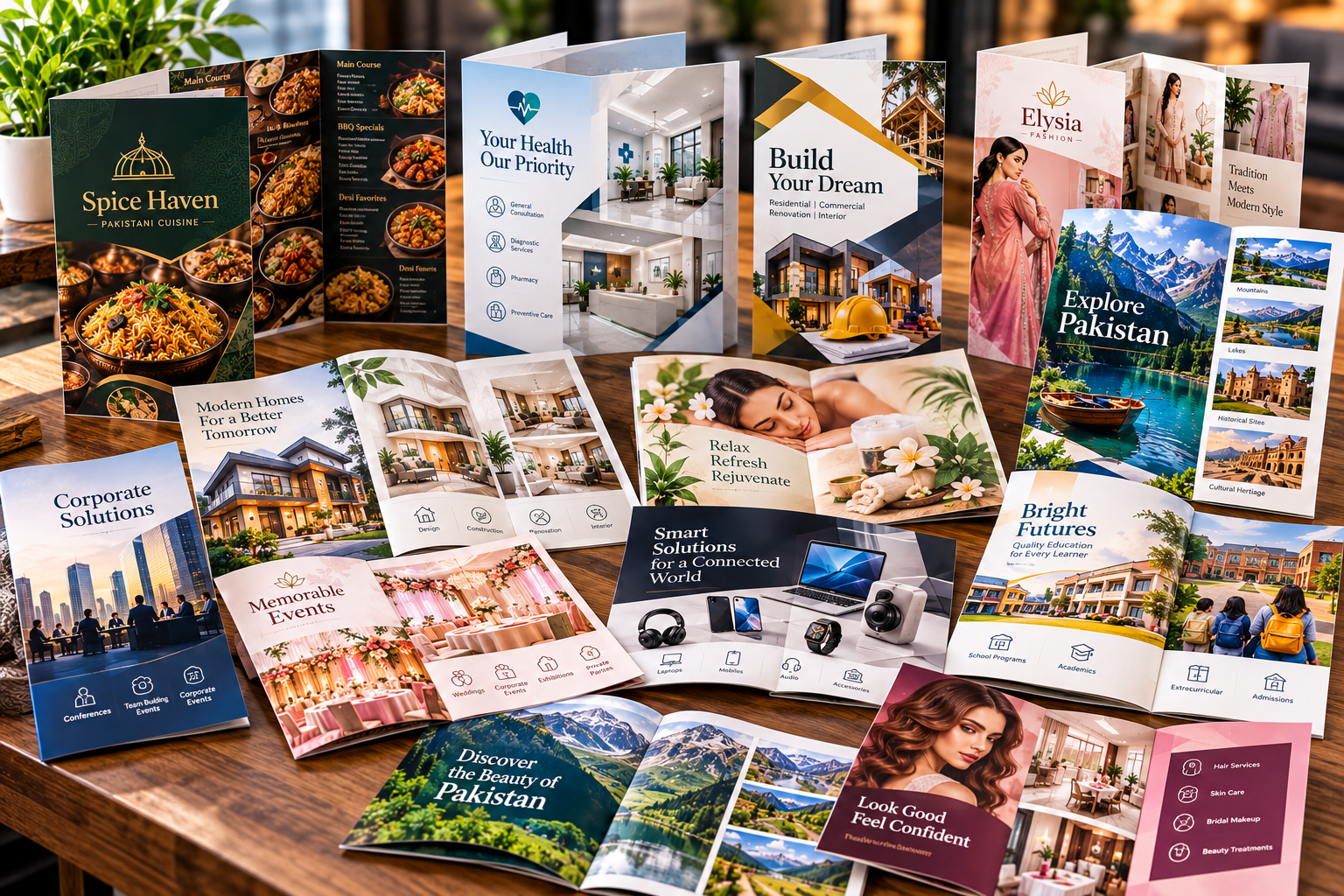
From light flyer paper to heavy card covers, pick the fold and the stock that suit what the brochure has to carry.
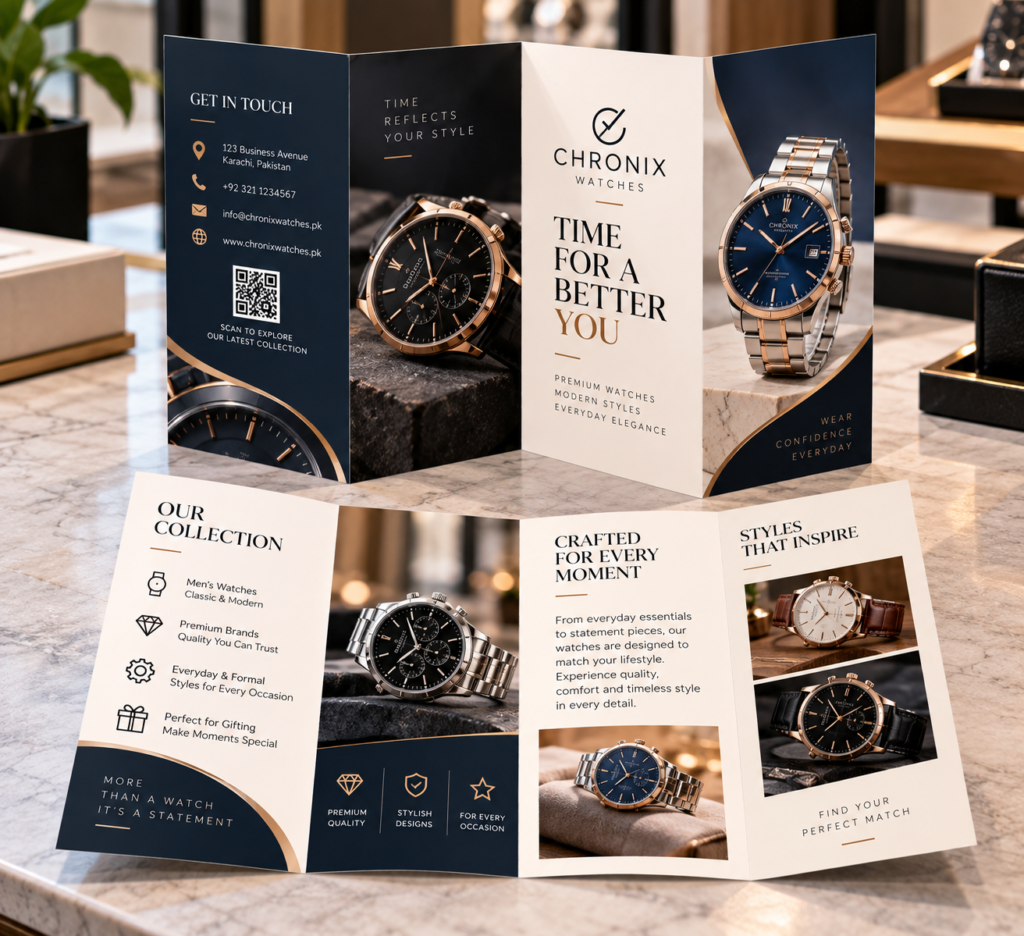
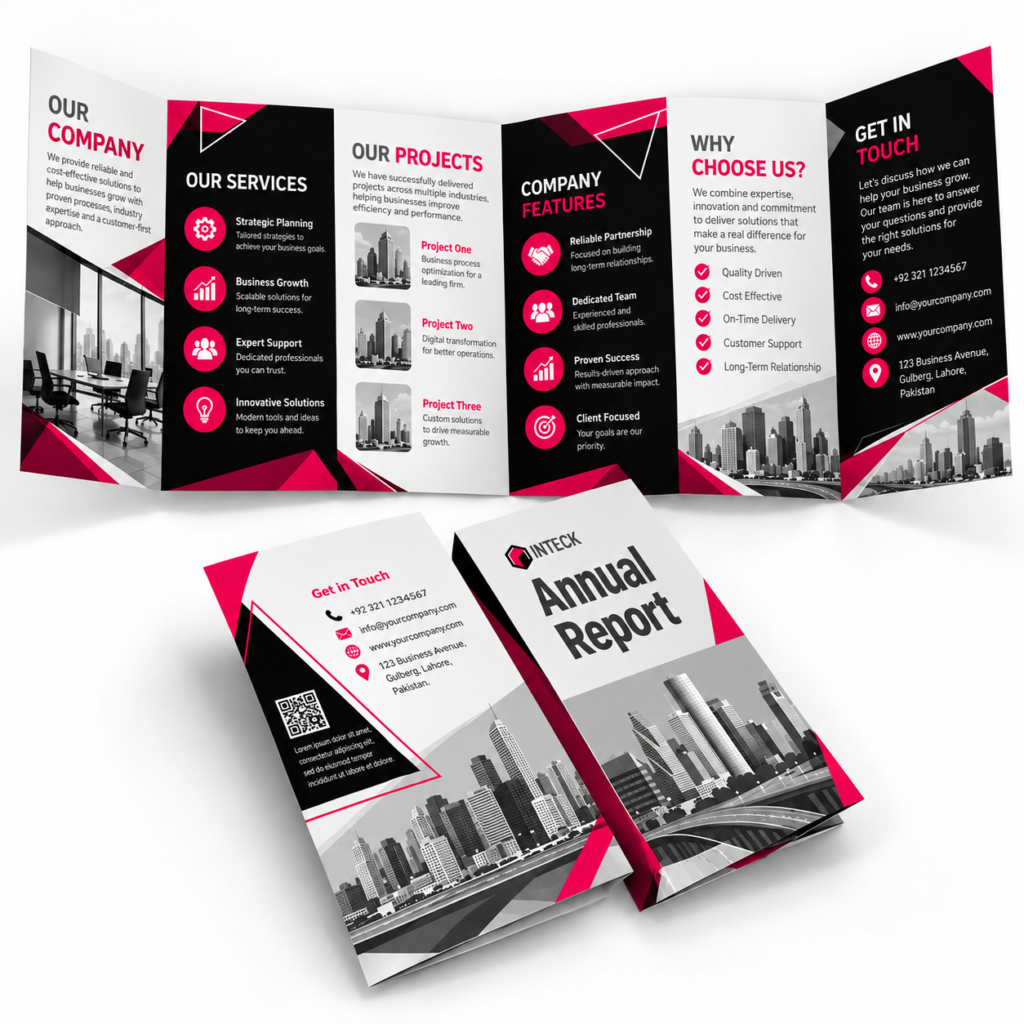
Six-panel gate fold brochures with two flaps that open outward from the…

Open it flat, let go, and the page stays put. Twin-loop wire…
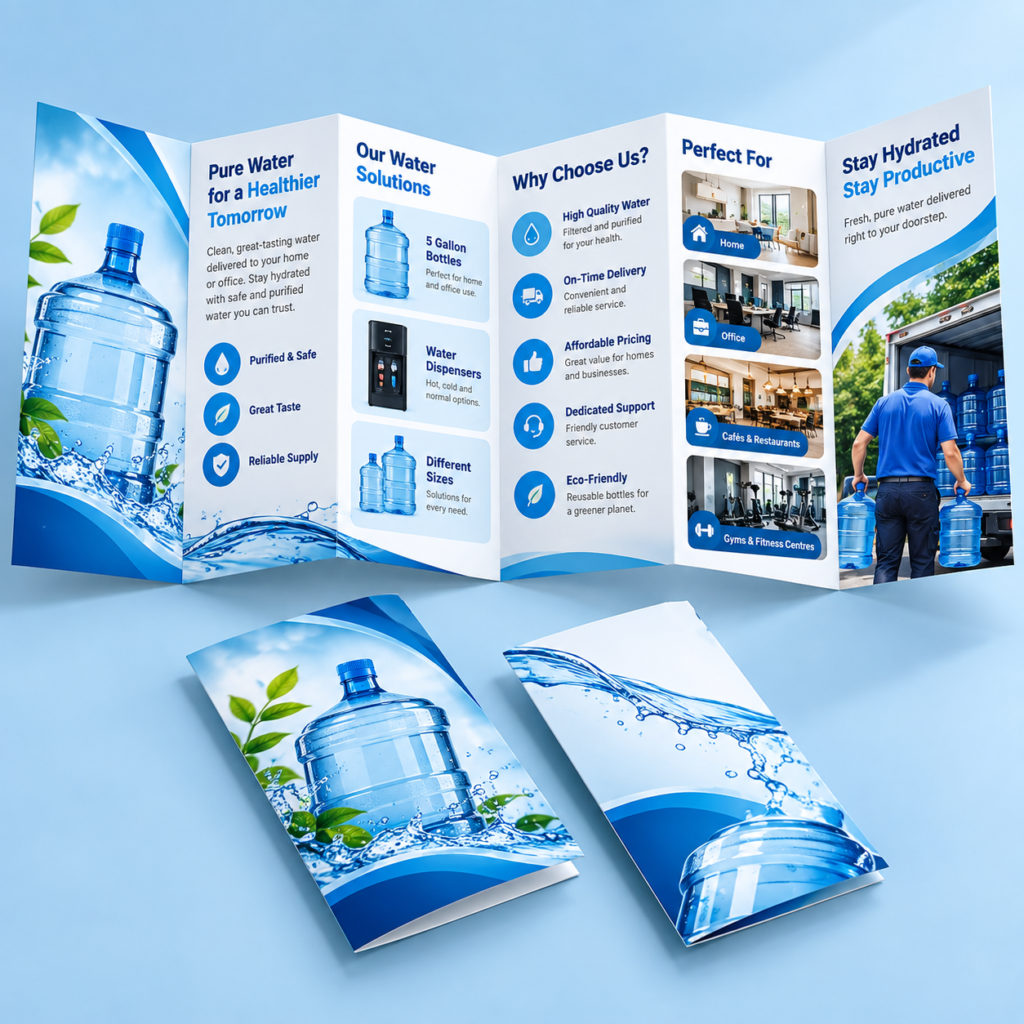
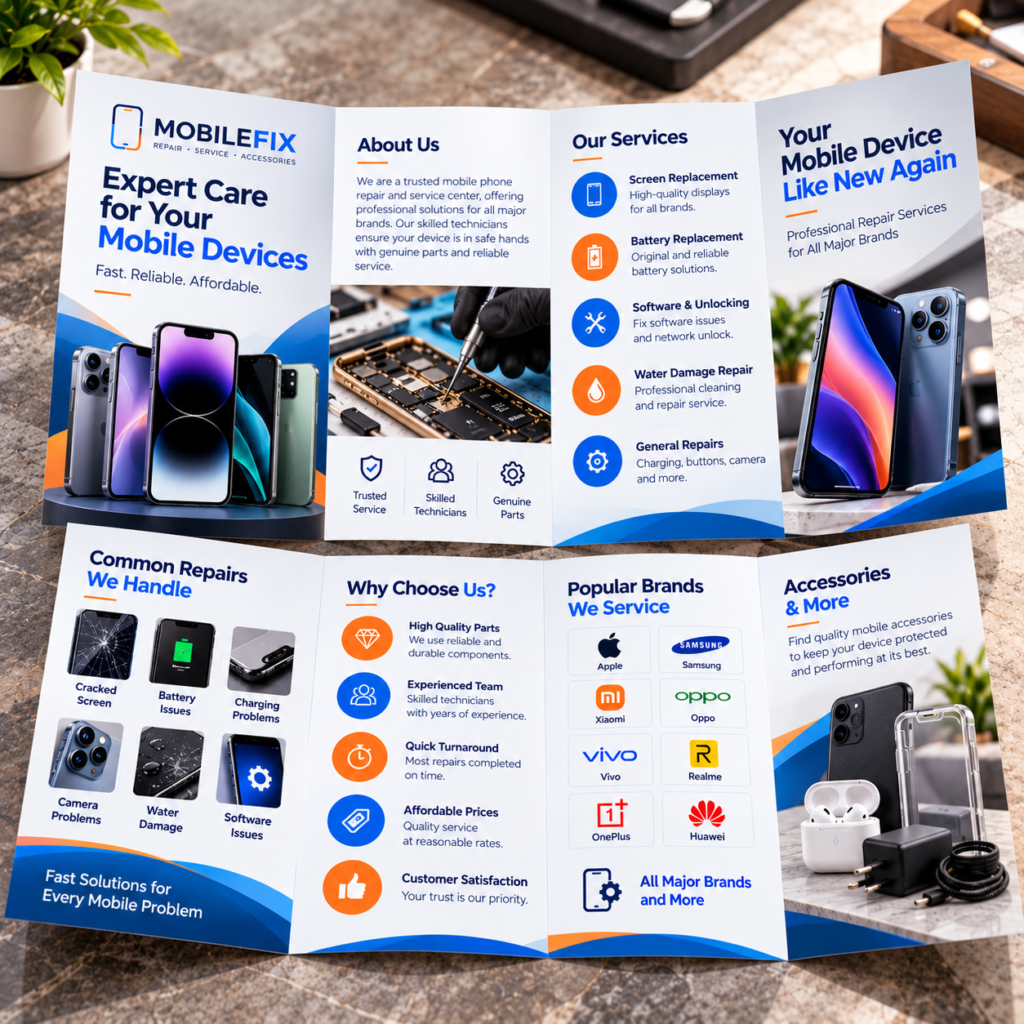
The fold decides how your content is read, in what order, and how much fits on a panel. Pick this before the design is laid out, not after, because changing the fold later means rebuilding the artwork from scratch. Every fold below is creased on the cutter before folding, so the paper bends instead of cracking.

One centre fold, four printable panels. It gives you the largest single panel of any fold, which is why it suits big images, floor plans and short product ranges that need room to breathe.

Two folds with one panel tucking inside. An A4 sheet finishes at DL size, so it fits a counter stand, a rack and a standard DL envelope. The most requested fold we print.

A concertina where every panel is the same width and the sheet opens into one continuous spread. Use it when the content runs in sequence: a timeline, a process, a site map, a payment schedule.

Two outer panels meet in the centre and open outward like doors onto a full-width spread. Worth the extra folding pass when one hero image or render is doing the selling.

Each panel folds into the next, with every inner panel cut slightly narrower so the roll closes flat. More content than a tri-fold without moving up to a stitched booklet.

Bound along one edge with a wire or coil so it opens completely flat and folds back on itself. The answer when a fold can no longer hold what you need to say, and it takes any page count rather than multiples of four.
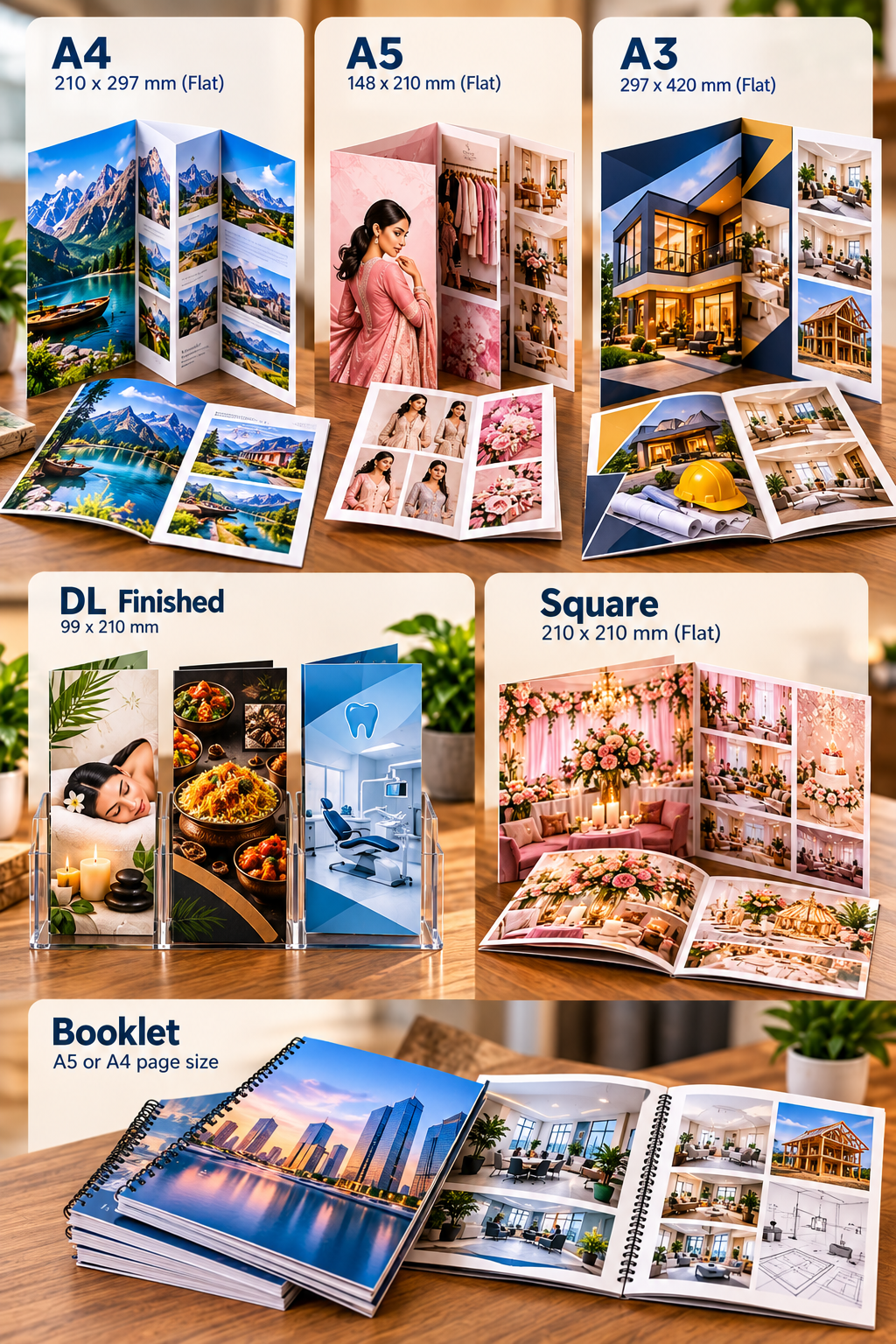
Sizes below are the flat sheet before folding, with the finished size after it. A4 folding down to DL is the working standard in Pakistan for handouts and counter brochures.
Custom flat sizes are available. Tell us the finished size you want and we will work back to the sheet, since some sizes cut more economically out of a press sheet than others.
Three card and paper types cover almost every job here. Plain is untreated, so it takes a pen. Matte has a smooth low-glare surface that holds fine detail and stays readable under strip lighting. Glossy is coated and shiny, and it makes photographs and strong colours look their best, though ink will not dry on it. Weight is the other half of the decision.
Brochure paper also has to fold without cracking. Above 170gsm the sheet is scored before folding, which we do as standard; unscored heavy stock splits along the fold and shows white fibre through the ink.

The workhorse for folded brochures. Low glare so long paragraphs stay comfortable to read, accurate colour, and it folds cleanly at lighter weights.

Brighter colour and sharper photographs, which is what a product or project brochure usually needs. Not the choice if anyone will write on it.

250 to 350gsm for single-fold brochures that need to feel like a document, and for booklet covers wrapping lighter inside pages. Always scored before folding at this weight.

Untreated, for brochures with forms, order panels or anything a reader fills in by hand. It also suits text-led company profiles where photography is not doing the work.

A brochure that is not white stands out in a rack of white ones. A single ink colour on kraft or a tinted sheet costs the same as full colour on white.

Cutting and creasing are digital, so a rounded corner, a shaped flap, a window cut into a panel or a custom outline all cost the same as a rectangle, with no die charge.
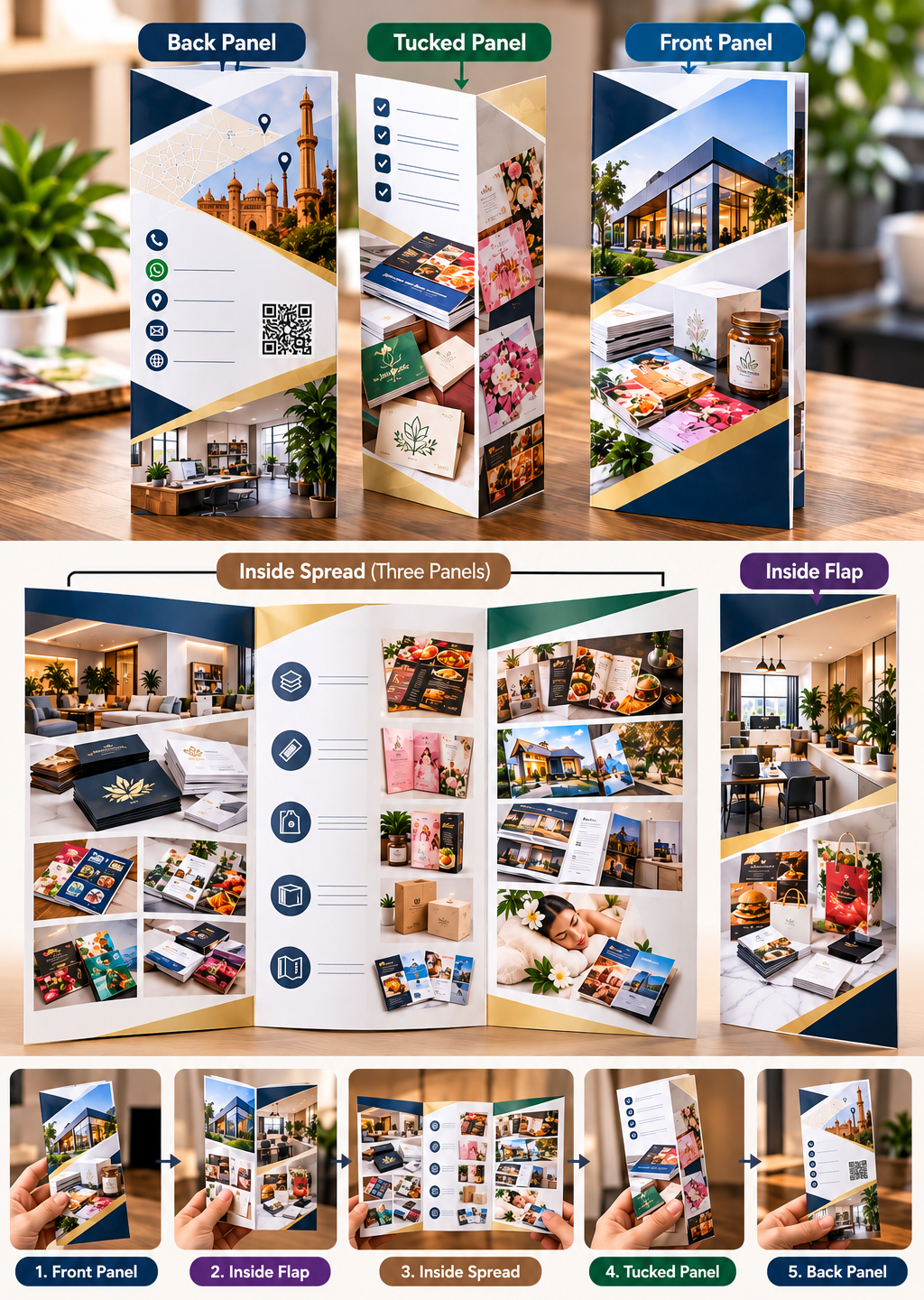
A brochure is not a flyer with folds in it. It is read in a fixed order, and content placed on the wrong panel gets skipped entirely. This is the running order for a standard A4 tri-fold.
One more thing worth deciding early: if the brochure carries rates, fees or a price list, put those on a loose insert rather than a printed panel. The insert can be reprinted on its own when prices move, and the main run stays usable.
Bilingual brochures are common here, usually English on one side of the sheet and Urdu on the other, or a mixed spread where headings run in both. Nastaliq needs different handling to Latin type, and on a folded piece there is one extra trap.
Sindhi, Pashto and Arabic follow the same rules. If you have the content but not the layout, send it across and we will typeset both languages.
Almost every brochure reprint we see comes from one of two things: a panel in the wrong place, or a fold that cracked. Both are avoidable before the job goes on press.
You get a proof that shows the sheet folded and numbered, so you can see which panel lands where before printing. Checking panel order on a flat PDF is where most mistakes slip through.
We look at panel widths, bleed, resolution, colour mode and how close your text sits to each fold line. If something will cause a problem, you hear about it while it is still fixable.
Anything above 170gsm is creased on a scoring rule first, so the fibres bend instead of splitting. It is the difference between a clean fold and a white cracked line through your cover image.
No plates and no setup charge, so twenty-five brochures is a real order. It also means you can print a hundred for an event this month and change the content before the next one, rather than living with a thousand out-of-date copies.
Choose a product from the range above, then set the flat size, the fold, the paper stock, any die-cut shape and the quantity.
Upload print-ready spreads, or send your logo, photos and content on WhatsApp and our designers will lay the brochure out for you.
You get a digital proof with fold lines and panel numbers marked. Check the panel order first, then spelling, numbers and prices.
Your brochures are printed, scored, folded, trimmed and boxed, then delivered in Karachi or couriered nationwide. Print files stay on record for reorders.
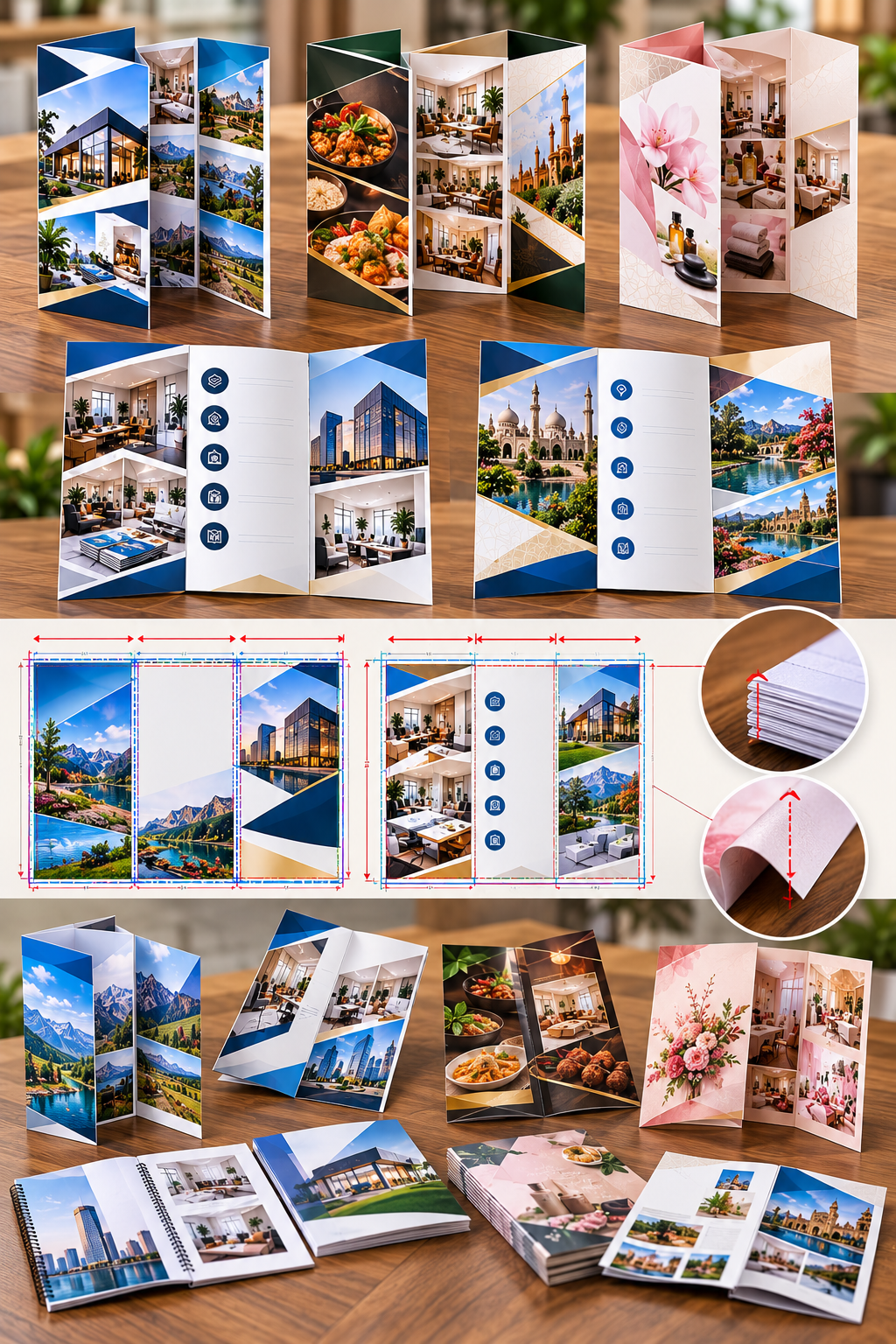
Brochure files fail for reasons flat artwork never does. Folding is mechanical, panels are not all the same width, and the trim moves slightly on every pass. These settings absorb all of it.
No layout yet? Send your logo, photos, content and the fold you want, and our design team will build the brochure before it goes to proof.
What the brochure has to carry decides the fold, and how it will be handled decides the stock.

Project brochures carry renders, floor plans and payment schedules, which means large flat panels and a stock heavy enough to feel like a document. A3 folding to A4 handles plans without shrinking them past readability.

Admission brochures are handled by hundreds of people over a session, so print them on heavier card and keep the fee structure on a loose insert, so the main run survives the next revision.

Service lists, test panels and department details work best as a Z-fold, where the reader can open the whole spread at once. An Urdu side makes the brochure usable for far more of the people who receive it.

Buyer-facing catalogues live or die on photography, so glossy paper is the sensible floor. Add an 85 x 55 mm contact panel or a matching card for overseas buyers filing your details.

Packages, itineraries and rates run in sequence, which is exactly what a Z-fold is for. Print the seasonal pricing separately so the brochure is not obsolete when the season changes.

Specification tables, part numbers and product ranges need legibility over gloss. Uncoated or silk stock with a roll fold gives you room for a long range without moving to a stitched booklet.
Everything here is printed digitally, so there are no printing plates and no setup charge to spread across the run. A short run is priced fairly rather than carrying the cost of preparing a press, a custom shape or fold adds nothing because cutting and creasing are digital too, and a different name, number or code on every piece costs the same as printing one design repeatedly. Quotes are in PKR.
| Quantity | Cost per piece |
| 25 – 100 | Highest per piece, though still viable |
| 250 | Noticeably lower |
| 500 | Best value on most jobs |
| 1,000 and above | Quoted per job |
Reorders are simple. Your files stay on record, so a repeat run needs no new setup and no new proof unless the artwork has changed.
Runs start at 25 pieces. Printing, cutting and creasing are all digital, so there is no plate charge and no cutting die, which makes a small run for one event or one client genuinely affordable. Cost per piece falls as the run grows, most noticeably at 250 and 500.
Match the fold to how the content is read. A bi-fold gives the biggest panels for images and plans. A tri-fold is the standard handout and finishes at DL for racks and envelopes. A Z-fold opens into one continuous spread, which suits timelines, itineraries and payment schedules. A gate fold builds a reveal around a single image. Past six panels of content, a wire-bound booklet is easier to read than a complicated fold.
Not if it is scored first. Above 170gsm we crease the sheet on the cutter before folding, so the fibres bend rather than split. Unscored heavy stock cracks along the fold and shows white through dark ink, which is the most common defect on brochures printed cheaply elsewhere.
The panel that folds inside must be 2 to 3 mm narrower than the other two, or the closed brochure will not sit flat. On an A4 tri-fold that works out to roughly 100 mm, 100 mm and 97 mm across the 297 mm sheet. For roll folds each inner panel narrows cumulatively. Tell us your size and fold and we will send the exact measurements before you start the layout.
Yes. Send Urdu as outlined curves or a print-ready PDF so the Nastaliq joins hold, and export from InPage to PDF rather than sending the .inp file. Remember that an Urdu brochure opens from the opposite edge, so the panel order mirrors the English side. If you have the content but not the layout, we will typeset both. Sindhi, Pashto and Arabic are handled the same way.
Print-ready PDF is best, supplied as two flat spreads, outside and inside, at full sheet size with 3 mm bleed, CMYK colour and fonts outlined or embedded. We also accept packaged INDD, AI, EPS, CDR from CorelDRAW and layered PSD files built at final size. For booklets, send single pages in reading order and we will handle the imposition.
Yes. Send your logo, photographs, the text you want included and a rough idea of the fold, along with a couple of brochures you like the look of. Our designers build the layout, send it as a folding proof, and adjust until you are happy before anything is printed.
Yes. We can send a stock sample pack so you can compare the paper weights and the plain, matte and glossy finishes in the hand, and a folded dummy of your own artwork can be produced ahead of the full run on request. A dummy is the only reliable way to check panel order.
Yes, wire-bound along one edge. It opens completely flat, which a stitched or glued booklet does not, and it takes any page count rather than multiples of four. For a company profile, a product catalogue or anything past six panels it is usually the better format anyway.
Screens emit light and mix colour in RGB, while presses lay ink on paper in CMYK. Bright blues, greens and oranges fall outside what ink can reproduce and shift when converted. Build in CMYK from the start and judge colour on the proof. Uncoated stock also absorbs more ink and reads softer than coated stock printed from the same file.
Across most of them, and the list keeps growing. The brochures we print regularly go to property developers and agencies, schools, academies and institutes, hospitals, clinics and labs, textile, leather and export units, hotels, travel and tour operators and distributors and industrial suppliers.
The trade matters less than what the job has to do. Two businesses in completely different lines often need the same size, stock and finish, and two shops in the same trade often need entirely different ones. If your line of work is not named above, tell us what the brochures have to do and where they will be handled, and we will tell you what suits it.
Yes. Orders are couriered anywhere in Pakistan, including Lahore, Islamabad, Rawalpindi, Faisalabad, Multan, Peshawar, Hyderabad and Quetta, and delivery within Karachi can be arranged directly. Folded brochures are boxed flat-packed in bundles so they arrive without creasing at the edges.
Pick a product from the range above and order on the site, or send your requirement on WhatsApp with the flat size, fold, stock, finish and quantity you want, and we will come back with a quote in PKR before anything moves forward.
Pick a product from the range above, or send your artwork, or just your content and photos, on WhatsApp. We will come back with fold and stock options and a quote in PKR.