Sharp printing, quality paper, unbeatable value – print custom business cards with the best in the game.
Nationwide Delivery
Across Pakistan
Premium Quality
Sharp & Vibrant Prints
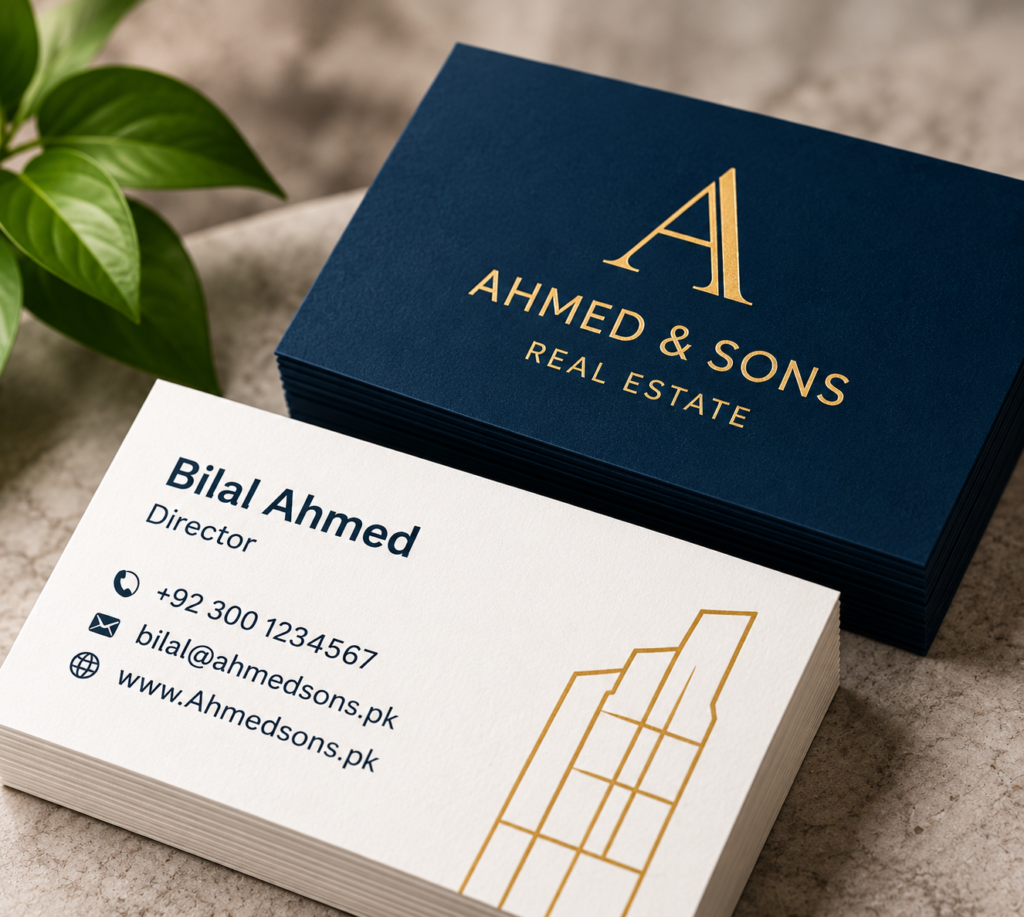
From standard to standout papers, get a look that pairs perfectly with your design.
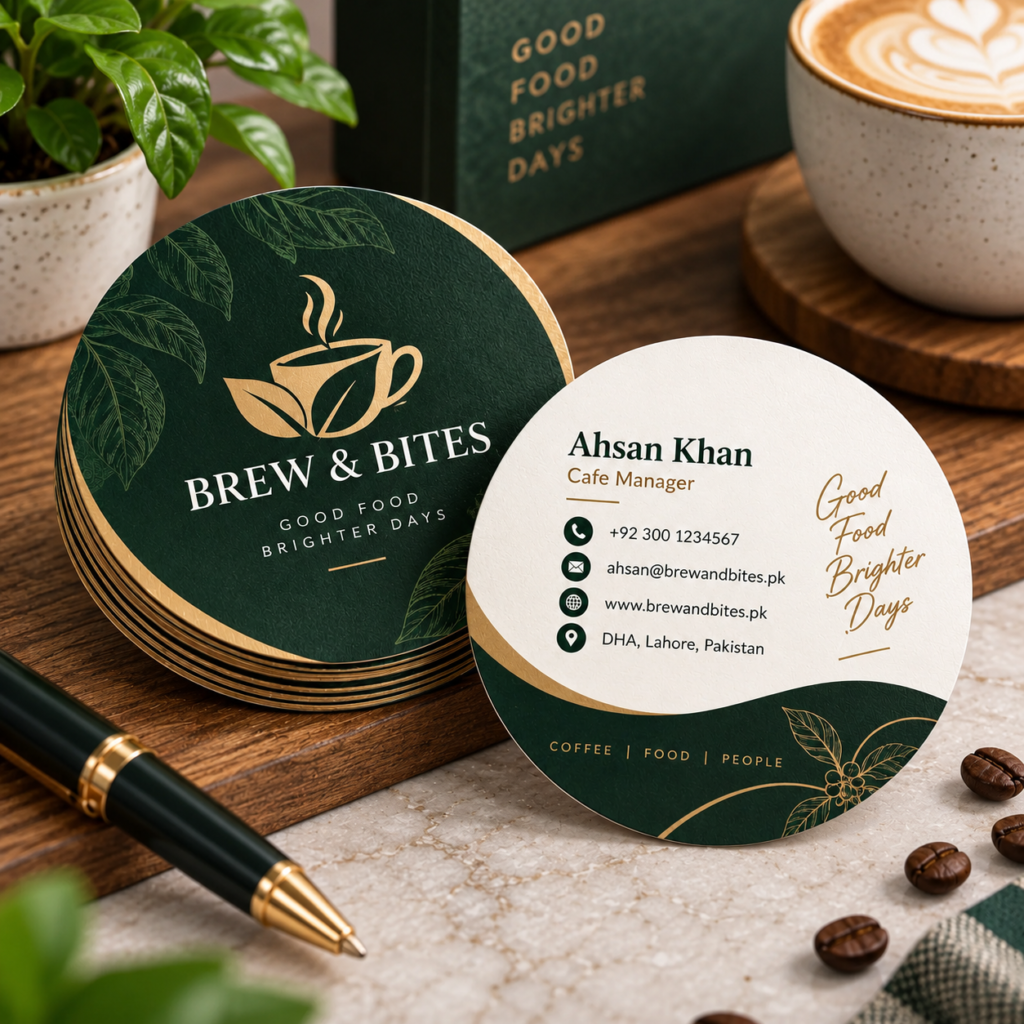
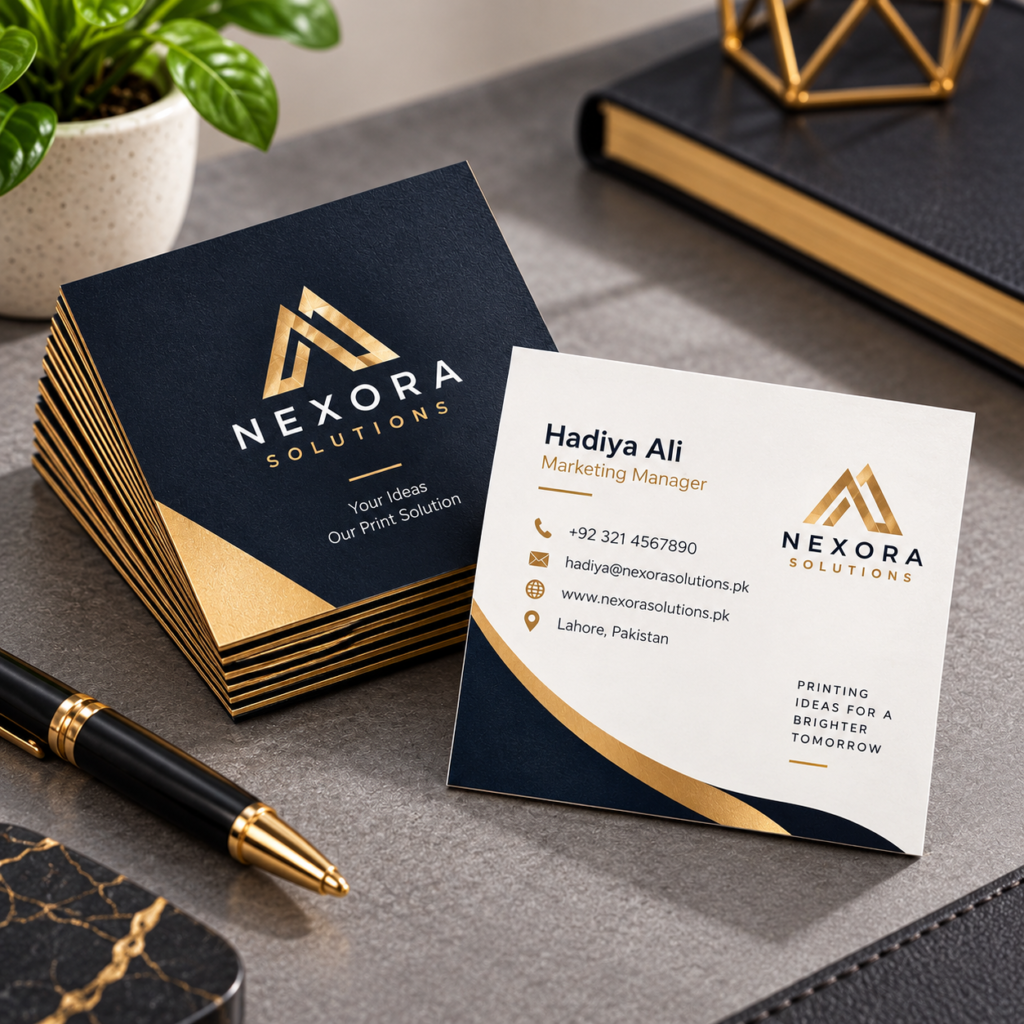
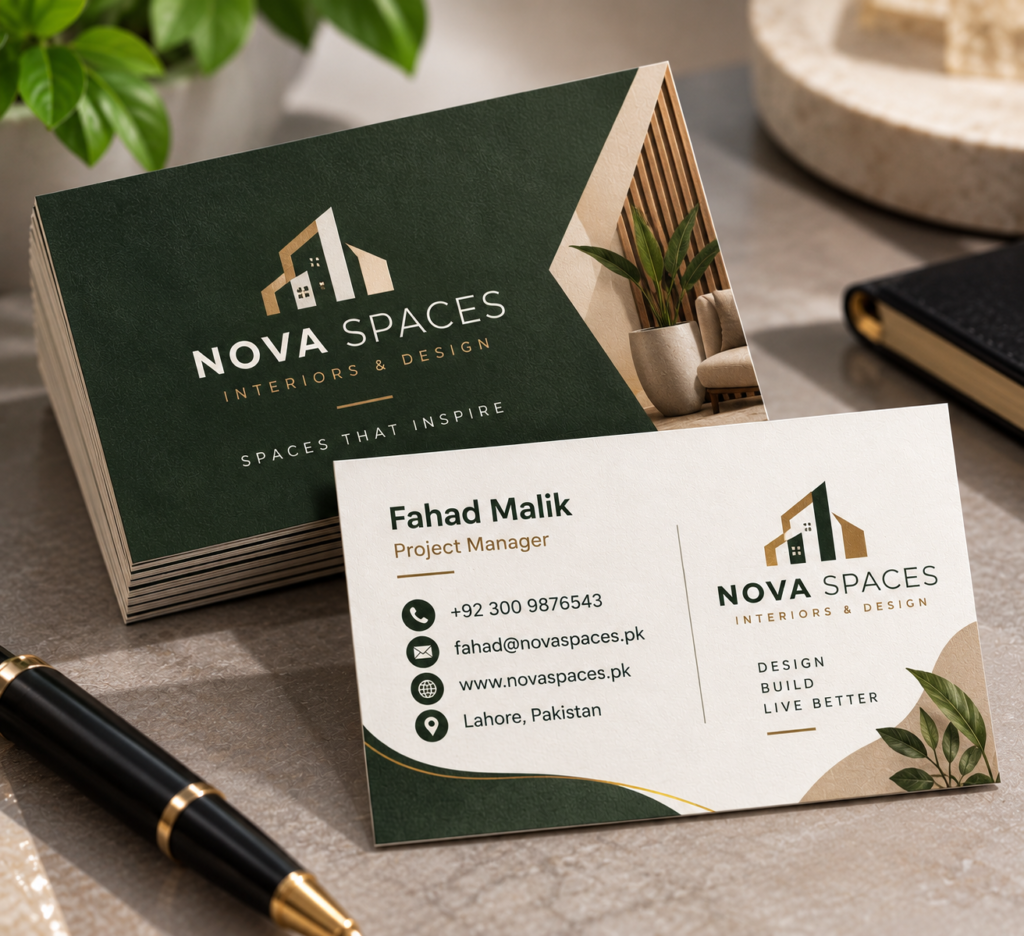
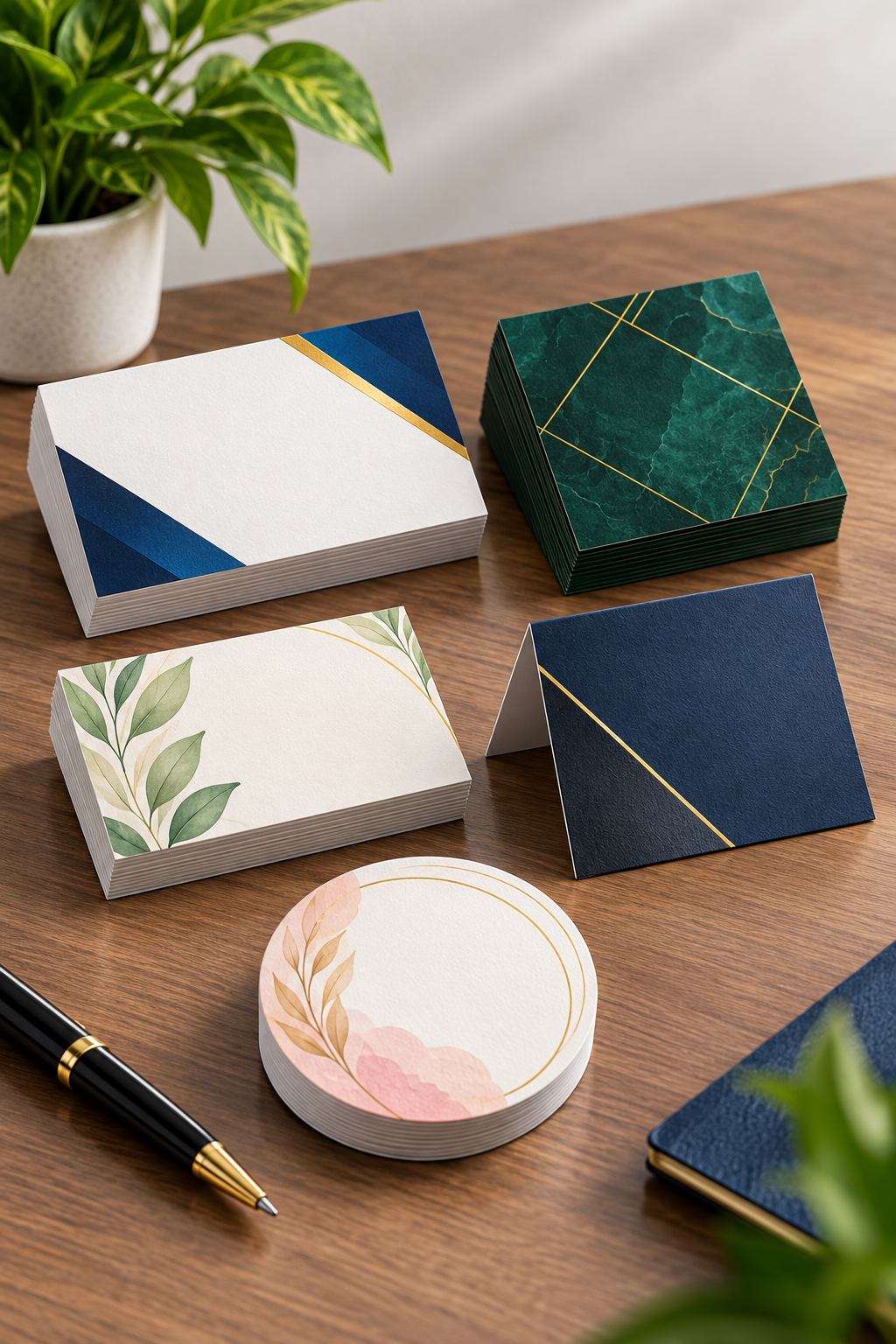
Three card types cover almost every job, and the difference between them is the surface rather than the brand of paper. Plain card is untreated, so it takes a pen. Matte card has a smooth low-glare coating that holds fine detail. Glossy card is coated and shiny, and it makes photographs and strong colours look their best. All three print sharply here. Weight is the other half of the decision, and 350gsm is where a card stops bending in a shirt pocket.

A smooth, low-glare coated surface. Colours stay accurate and small type stays crisp without the shine bouncing off under an office light. The safest all-round choice for a card that carries a logo and a block of contact details.

A shiny coated surface that lifts photographs, deep colours and dark backgrounds. It is the finish people recognise instantly as a printed card. Bear in mind that pen will not dry on it, so keep glossy for cards nobody needs to write on.

Untreated on both sides, with a natural paper feel. Ink settles into the fibre rather than sitting on a coating, which gives a muted, understated look, and the back takes ballpoint cleanly if you write appointment dates or prices on it.

Ivory, cream, grey, black and natural kraft. On a coloured card a single ink colour often reads better than full colour on white, and it costs exactly the same to print.

Because cutting is done digitally from your artwork rather than with a metal die, any outline costs the same as a rectangle. Rounded ends, a shape cut around your logo, a notch, a slot for a lanyard: all of it is one cutting pass and none of it carries a die charge.

A 3 mm or 6 mm corner radius stops cards dog-earing in a wallet, and it is cut in the same pass as the outline. Punched holes, slots and tear-off sections are cut the same way, which is how a card becomes a tag, a pass or a loyalty stub.
The 90 x 50 mm card is the working standard across Pakistan. It fits every wallet, card holder and visiting-card file in the country, and if your card is going into a stack with fifty others at a trade counter, matching that size is the safest choice.
Weights run from 250gsm for a light card up to 400gsm for something that feels substantial in the hand. 300gsm is the usual choice and 350gsm is where the card stops flexing in a wallet.
Custom die-cut shapes are available. Send the outline as a vector path and we will confirm whether it cuts cleanly on the stock you have chosen.
Plenty of cards here carry English on the front and Urdu on the back, or an Urdu name line sitting under an English one. Both work, but Nastaliq behaves differently to Latin type on press and a few things are worth getting right before the file is sent.
Sindhi, Pashto and Arabic set the same way and follow the same rules. If you want a bilingual card and are not sure how to split the two sides, send us the details and we will lay out both.
Most reprints happen because something small was missed before the file went on press. We check for those things first.
Before anything is printed we look at resolution, bleed, colour mode and how close your text sits to the trim. If something will cause a problem, you hear about it while it is still fixable.
You approve a layout proof showing trim, bleed and both sides of the card. Nothing goes on press until you sign it off, so there are no surprises when the box arrives.
Plain, matte and glossy card look almost identical on a screen and completely different in the hand. Ask for a sample pack and see how each one takes your logo colour, and whether the back still takes a pen, before a full run is printed on it.
Short runs are priced properly here rather than penalised. There are no plates and no setup charge, so fifty pieces is a real order and not a favour. Several different designs, or a different name on every piece, cost the same as printing one design over and over.
Choose a product from the range above, then set size, stock, finish, single or double-sided printing, and quantity.
Upload a print-ready file, or send your logo and details on WhatsApp and our designers will lay the card out for you.
We send a digital proof with trim and bleed marked. Check spelling, phone numbers and URLs carefully, then approve.
Your cards are printed, finished, cut and boxed, then delivered in Karachi or couriered anywhere in Pakistan. Your print file stays on record for reorders.
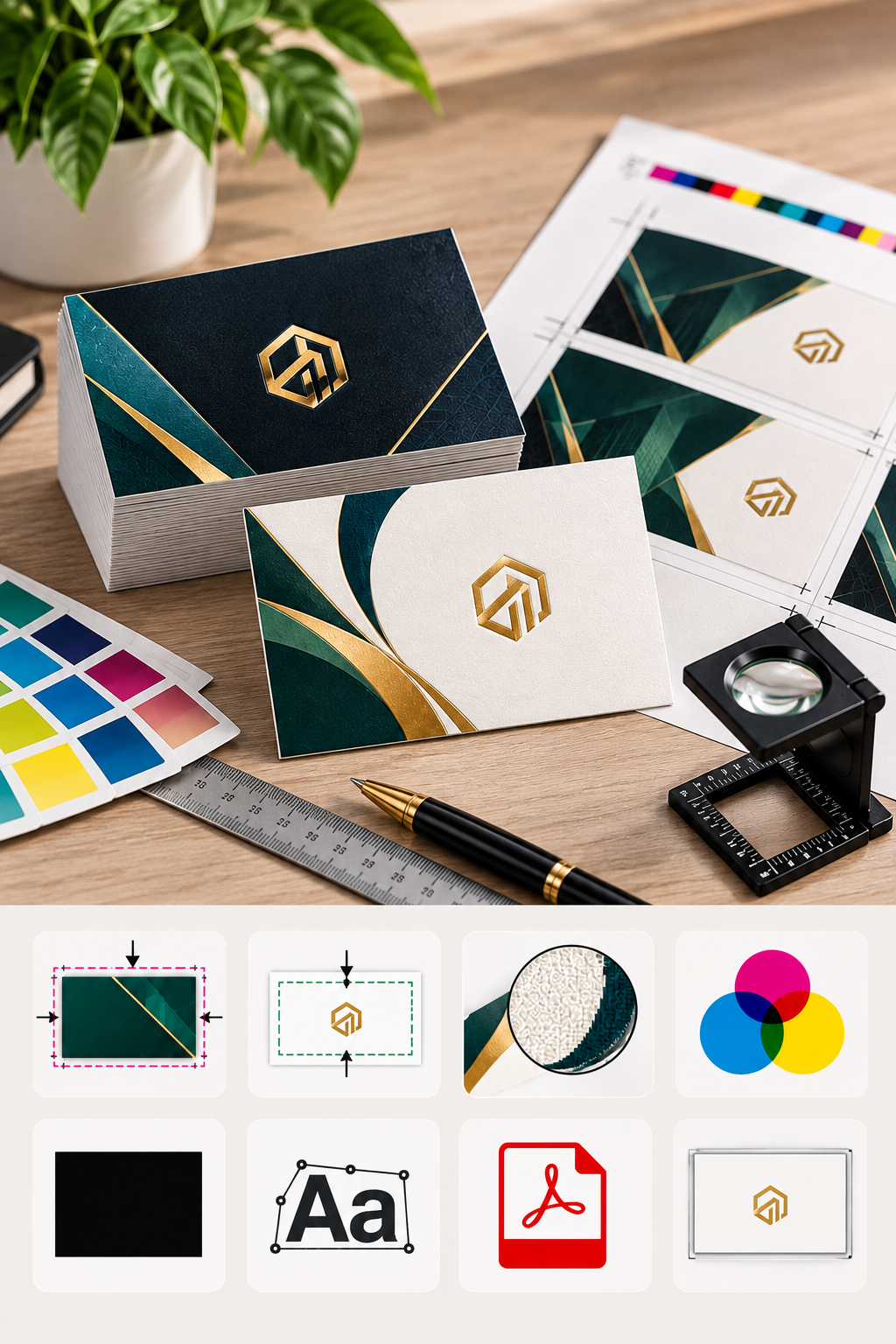
Cards are printed on large sheets and then cut, and cutting shifts by a fraction of a millimetre on every pass. These settings absorb that movement so nothing important lands on a blade.
No artwork yet? Send your logo, contact details and any brand colours you already use, plus a couple of cards you like the look of, and our design team will build it before it goes to proof.
What a card has to survive says a lot about how it should be printed.

These cards get handed over on plots, in site offices and across estate agency counters, then filed for months before anyone calls. Print on 400gsm so the card survives that handling, and use the back panel for society names, project locations or a plot listing.

Trading cards travel: sample rooms, mandis, buyer meetings and export enquiries. Keep the layout plain and legible, put product categories on the reverse, and consider adding 85 x 55 mm export-size cards if you deal with overseas buyers.

Print the front on matte or uncoated stock so the back stays writable for the next appointment date. An Urdu name and designation line under the English one helps a lot of patients read the card at a glance.

Print the front on a coloured or kraft stock and the card stops looking like every other restaurant card in the pile. A folded or die-cut card gives room for delivery numbers, timings and a QR code straight to your WhatsApp.

Smaller runs suit people who rebrand or change roles often. Square and slim formats stand out in a stack, and a QR code pointing at your portfolio or WhatsApp saves reprinting the whole batch when a link changes.

One approved template, a list of names, branches and area codes, and every set arrives bundled and labelled per person or per outlet. Add staff later and the layout stays identical to the first batch.
Everything here is printed digitally, so there are no printing plates and no setup charge to spread across the run. That changes the arithmetic in your favour at small quantities: a run of fifty is priced sensibly rather than carrying the cost of a press being made ready. It also means a custom shape, a second design or a different name on every piece adds nothing to the price. Quotes are in PKR.
| Quantity | Cost per piece |
| 25 – 100 | Highest per piece, though still viable |
| 250 | Noticeably lower |
| 500 | Best value on most jobs |
| 1,000 and above | Quoted per job |
Before you settle on a number, lock down the details that change most often: WhatsApp number, branch address, designation and any link printed on the card. A thousand cards carrying an old number cost more than five hundred reprinted later.
If several people in the business need cards, send all the names together. Printing digitally means a different name on every card costs nothing extra, so a set for the whole team is priced as one job.
Reorders are simple. Your approved print file stays on record, so a repeat run needs no new setup and no new proof unless something on the card has changed, and printing on the same stock keeps colour consistent between batches.
Runs start at 25 cards. Because we print digitally there are no plates and no setup charge, so a small run is priced fairly rather than carrying the cost of preparing a press. The cost per card still falls as the run grows, most noticeably at 250 and 500.
Yes. Send the Urdu as outlined curves or a print-ready PDF so the Nastaliq joins hold, and if you work in InPage, export to PDF rather than sending the .inp file. If you only have the text and no layout, send it across and we will typeset both sides. Sindhi, Pashto and Arabic are handled the same way.
Yes, on every stock we carry. The back is useful space: a service or rate list, a QR code, branch addresses, an Urdu name line, or a blank area on uncoated stock for writing appointment dates.
Print-ready PDF is best, exported at 300 DPI in CMYK with 3 mm bleed and fonts outlined or embedded. We also accept AI, EPS, CDR from CorelDRAW, packaged INDD and layered PSD files built at final size. Please avoid logos saved from a website or received on WhatsApp, since they do not carry enough detail to print sharply.
Yes. Send your logo, contact details and any brand colours or fonts you already use, along with a couple of cards you like the look of. Our designers lay out the card, send it as a proof, and adjust it until you are happy before anything is printed.
Screens emit light and mix colour in RGB; presses lay ink on paper in CMYK. Very bright blues, greens and oranges sit outside what ink can reproduce, so they shift slightly when converted. Building the file in CMYK from the start and judging colour on the proof keeps that gap small. Uncoated stock also absorbs more ink and reads softer than coated stock printed from the same file.
Rounded corners are available at 3 mm or 6 mm radius on any size. For a fully custom outline, send the shape as a vector path and we will check that it cuts cleanly on your chosen stock. Very thin protrusions and sharp internal angles tend not to survive the cut, and we will suggest an alternative if that is the case.
Matte for most business cards: low glare, accurate colour and crisp small type. Glossy where a photograph or a strong dark colour is doing the work, remembering that pen will not dry on it. Plain card where the back needs to be written on, or where you want an understated, natural look. We can send a sample pack so you can compare all three in the hand before deciding.
Across most of them, and the list keeps growing. The business cards we print regularly go to property dealers and builders, textile, garments and general trading, doctors, clinics and pharmacies, restaurants, cafes and caterers, freelancers, IT and agencies and distributors, wholesalers and shops.
The trade matters less than what the job has to do. Two businesses in completely different lines often need the same size, stock and finish, and two shops in the same trade often need entirely different ones. If your line of work is not named above, tell us what the business cards have to do and where they will be handled, and we will tell you what suits it.
Yes. Orders are couriered anywhere in Pakistan, including Lahore, Islamabad, Rawalpindi, Faisalabad, Multan, Peshawar, Hyderabad and Quetta, and delivery within Karachi can be arranged directly.
Pick your card from the range above and place the order on the site, or send your requirement on WhatsApp with the quantity, size, stock and finish you want and we will come back with a quote in PKR before anything moves forward.
Pick a card from the range above, or send your artwork, or just your logo and details, on WhatsApp. We will come back with stock options and a quote in PKR.